Fil rouge · N° 02 · AI & school
My third-grader keeps asking for her homework
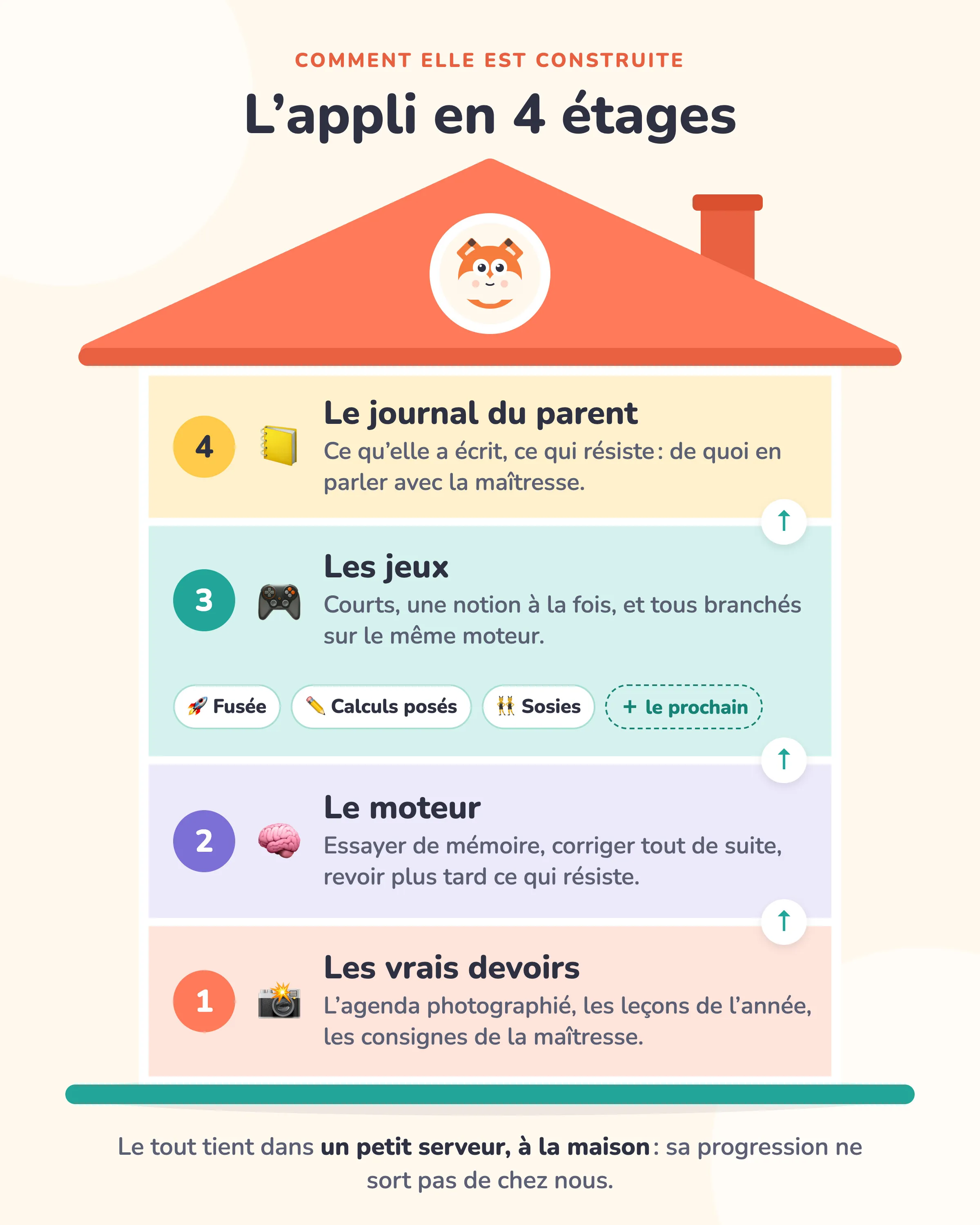
A few days ago, my youngest came home from school with mistakes in her column arithmetic, things like 543 + 309 or 543 − 319. The classic third-grade traps: the forgotten carry, the “9 − 3” written instead of an impossible “3 − 9”.
That same evening, a module made just for her was waiting: the grid from her exercise book, guided column by column, and an app that recognizes her traps the moment she falls into them.
That module didn’t exist when she came home from school. I built it while she was having her after-school snack.
Why education is on my mind
Education has interested me for a while, and since generative AI arrived, it has been on my mind a lot. Because AI can do two opposite things: do the homework for the student, or help them learn. As the dad of two kids, one in elementary school and one in middle school, it obviously weighs on me all the more.
A study published in PNAS in 2025, with about 1,000 high school students, measured it. With ChatGPT as is, students did 48% better on their exercises… then did 17% worse than the others once the tool was taken away. With a tutor that gave hints without ever handing over the answer, no loss.
Same technology, two uses, two outcomes.
And then there’s the news. In recent weeks, French high school students blockaded their schools, then education staff went on strike, from elementary school to university: understaffing, overcrowded classes, jobs cut in the 2027 budget.
My daughters aren’t in high school yet. The youngest is in third grade. She’s the one I’m going to talk about in this article.
One pace for a whole class
In elementary school, I see committed teachers who do a lot with very little. But a crowded class means one pace for everyone. Individualizing isn’t just a matter of goodwill: it’s a matter of time and tools, and neither is there.
And yet I’m convinced that no single method works for everyone. Some kids can focus for forty minutes; others drift off after five, and do very good work if the session is short and they can move around. Some remember what a word looks like; others need to understand why it’s spelled that way.
Simple techniques, once you know them
My wife has also spent a huge amount of time with her these past few months, supporting her with various proven techniques. But while spending time supporting your child can be enjoyable in a way, it’s also an extra load that isn’t always possible to carry day to day.
The breakthrough came from a learning specialist. For the week’s spelling words, for example, she suggested a ritual: study them quietly in her bedroom, then come back down to the living room to write them.
Digging deeper, I understood what makes this ritual work: the time that passes in between, and writing without a model in front of you. You have to go fetch the word from memory, and that effort is what anchors it.
Other techniques of the same kind followed:
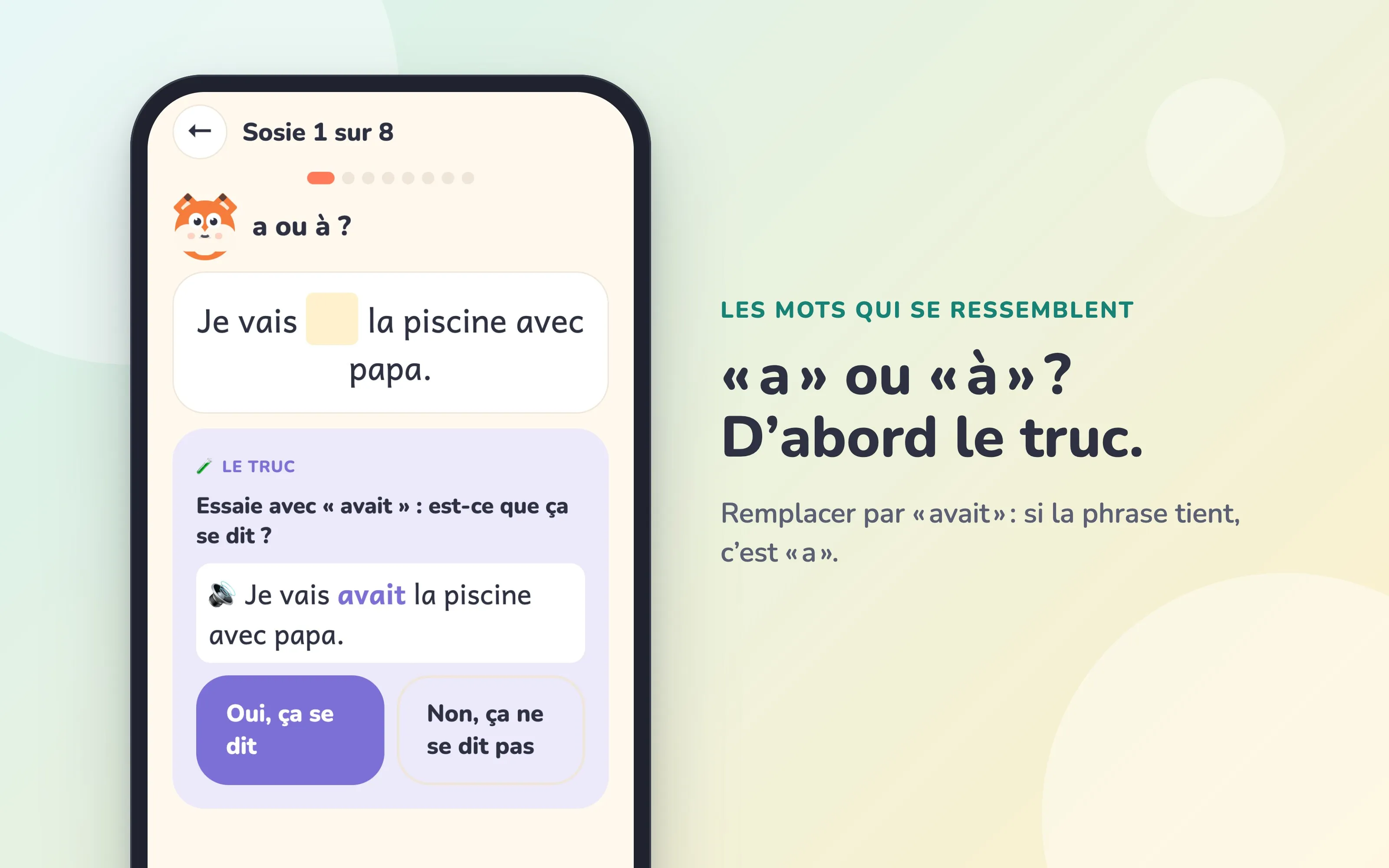
- “a” or “à”, the classic French mix-up? Swap in “avait”: if the sentence still holds, it’s “a”.
- To find the verb, make the sentence negative: in French, “ne… pas” wraps around it.
- To count by tens, really jump: a small jump is worth 1, a big jump is worth 10.
Nothing revolutionary. You just had to think of it… and do it every day, at the right time, on the right words. That’s where it gets stuck, and that’s where a tool can help.
How the app is built
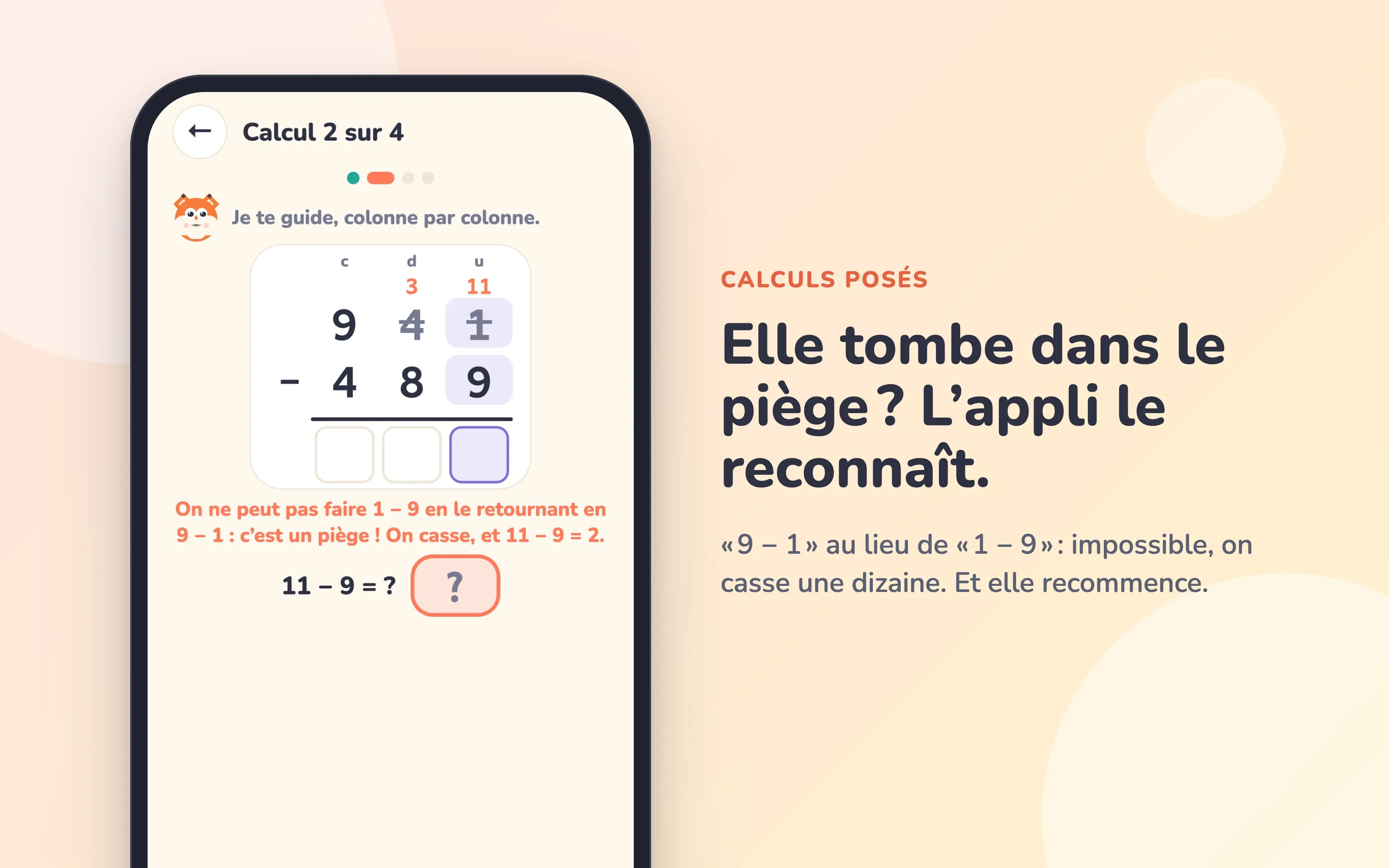
So I built an app for her alone. It stands on four pillars.
1. Her real homework as input. I take a photo of her homework planner, the app pulls out the week’s word list, and I check it: a word miscopied in class, then learned for a whole week, is the worst-case scenario. The year’s lessons are loaded in: more than 700 spelling words, grammar, conjugation. When her teacher asks her to count backwards from 209 to 170, I type it in, and the exercise becomes a mission, even a game.
2. A learning engine. Always the same loop: try from memory, get corrected right away, come back later to what doesn’t stick. Never an answer before she has searched for it herself.
3. Short games around each concept. A rocket that lifts off when she has counted down past a hundred: 201, 200, 199… A machine that makes up wacky sentences to conjugate. A detective who sniffs out a word’s tricky letters before she writes it, and so on. A voice reads out the words, numbers and sentences, and a virtual companion she picked keeps her company.
4. A log for the parents. What she wrote, what doesn’t stick yet, concept by concept. Enough to talk it over with her teacher or her learning specialist.
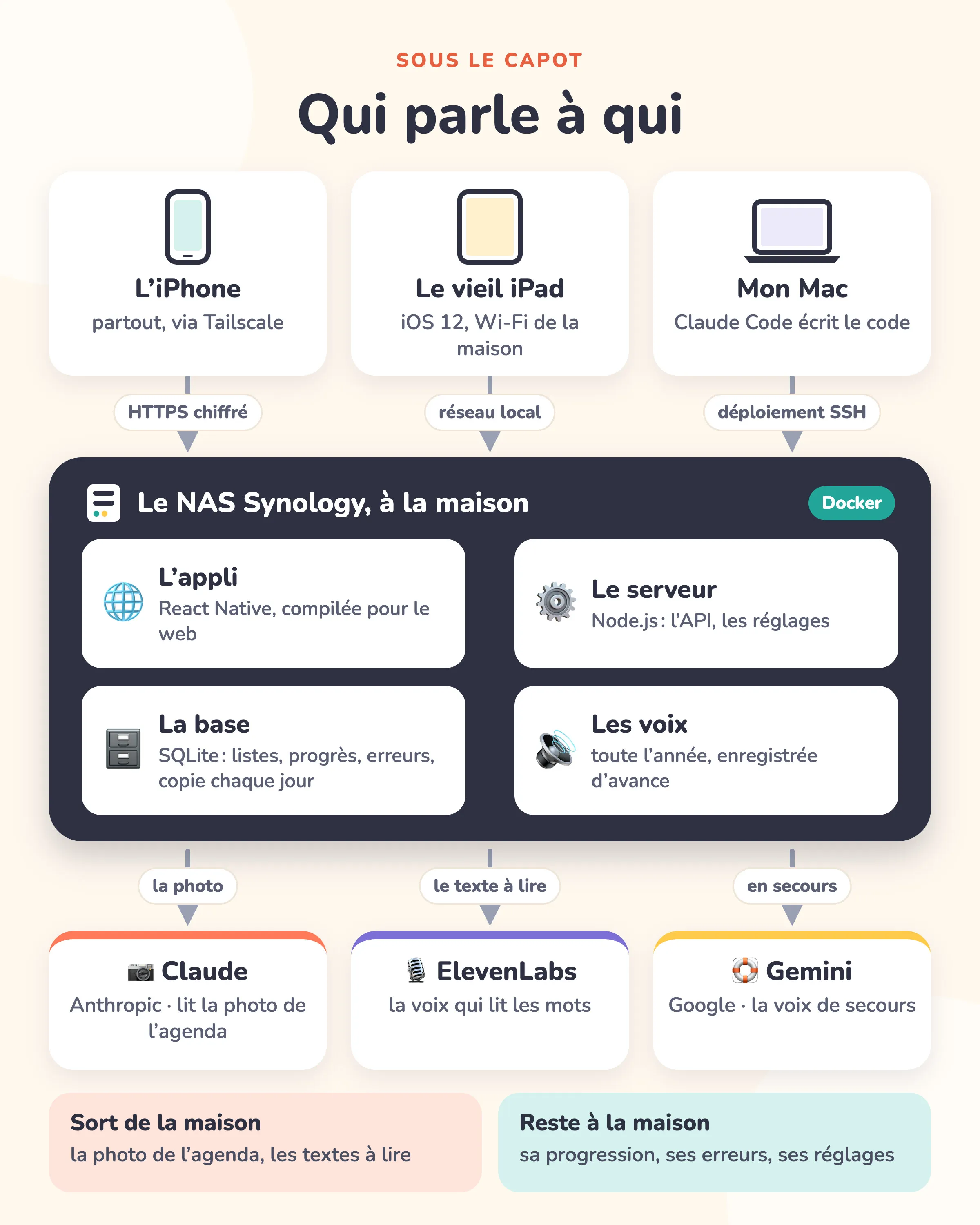
It all runs on a small server at home: her progress and her mistakes never leave our house.
What’s really new: flexibility
This is where everything changes. When a need shows up, the app follows, often that same evening. Mistakes in column arithmetic? A column arithmetic module, set to her class’s subtraction method. A lesson on look-alike words, “a” or “à”, “son” or “sont”? Two games to practice.
It’s fast because every new game plugs into the same engine, which already knows what she has mastered and what doesn’t stick yet. Software becomes made to measure.
And the roles are clear. I decide what to work on and how, based on feedback from school and the learning specialist’s advice. An AI writes the new module. My daughter tests it right away.
How it’s going, so far
The title isn’t just a turn of phrase: she keeps asking for her homework. Or rather, for the app that holds it.
I’m staying cautious, because nothing in it is designed to hook her: no notifications, no streak to keep alive, no random rewards. Short sessions that stop cold, and stars that reward effort.
Above all, everything is connected. What she does in the app is what her teacher expects, when she expects it. Homework and fun finally pull in the same direction.
But it’s the very beginning. I haven’t measured anything, and this app replaces neither her teacher nor the professionals. It extends their work at home.
The real question
I’m a developer, I have an incredibly powerful AI at my disposal, and I know how to use it. That’s a privilege, and I’m aware of it.
So the question isn’t “one app per child.” It’s: how do we put this made-to-measure approach in teachers’ hands, for a whole class? The techniques exist, the research on memory is solid, and AI makes tools much cheaper to build. What’s missing is the time and the means to use them.
This is only the beginning of my experiments, and I really want to go further. Teachers, learning specialists, speech therapists, parents: what do you need to individualize? I’d love to hear from you.
In the meantime, I have 100 other ideas to build for her, and I’ve already started exploring how to adapt all this for my eldest, in seventh grade. Her personality and work habits are completely different from her sister’s. That will only make this new experiment more interesting.